
Free crochet tool
Crochet sphere calculator
Tell it how big the ball should be and how tightly you crochet, and it works out the increase and decrease rounds for you. You get the pattern itself — every round with its stitch count — and a button that opens it in the 3D planner, where you can watch it build and keep editing.
The pattern, round by round
| Round 1 | 6 sc in ring | → 6 |
| Round 2 | inc x6 | → 12 |
| Round 3 | (sc, inc) x6 | → 18 |
| Round 4 | (2 sc, inc) x6 | → 24 |
| Round 5 | (3 sc, inc) x6 | → 30 |
| Round 6 | (4 sc, inc) x6 | → 36 |
| Round 7 | (5 sc, inc) x6 | → 42 |
| Round 8 | (6 sc, inc) x6 | → 48 |
| Round 9-16 | 48 sc | → 48 |
| Round 17 | (6 sc, dec) x6 | → 42 |
| Round 18 | (5 sc, dec) x6 | → 36 |
| Round 19 | (4 sc, dec) x6 | → 30 |
| Round 20 | (3 sc, dec) x6 | → 24 |
| Round 21 | (2 sc, dec) x6 | → 18 |
| Round 22 | (sc, dec) x6 | → 12 |
| Round 23 | dec x6 | → 6 |
| Finishing | fasten off |
How the maths works
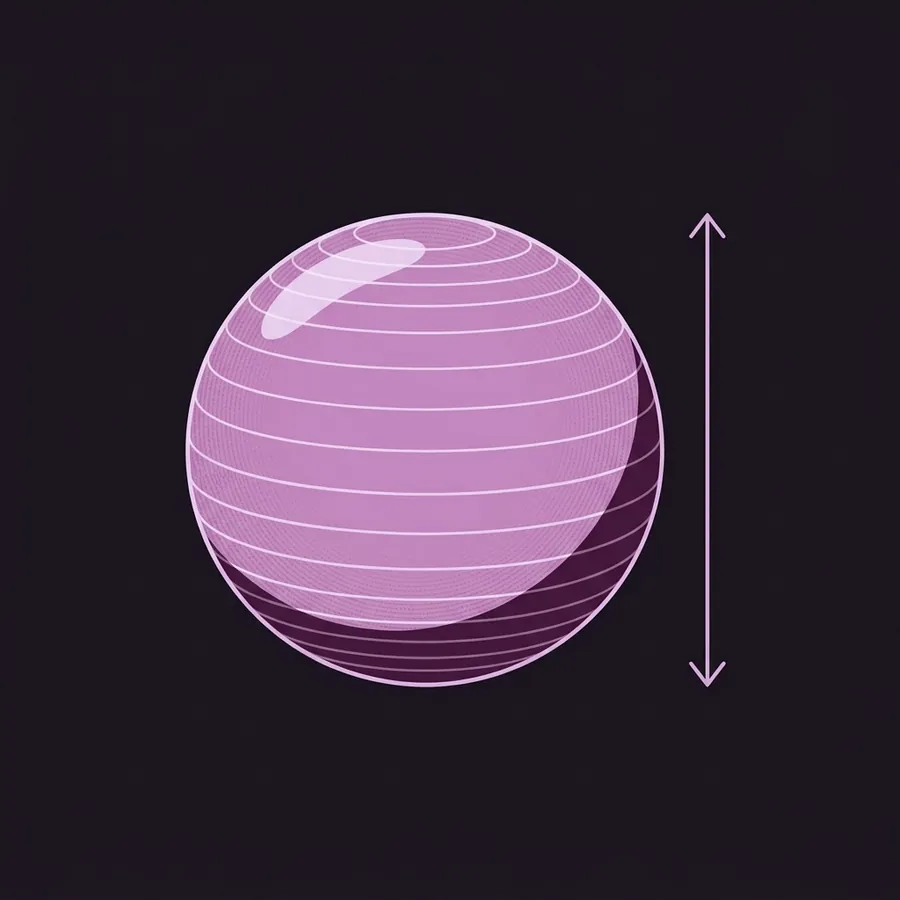
A crocheted sphere is two domes back to back. You start with six stitches in a magic ring and add six every round, so after n increase rounds the widest round has 6n stitches. That widest round is the circumference at the equator, measured in stitches — so with a stitch gauge it becomes a circumference in centimetres, and the diameter is that divided by π.
Then you work straight for about as many rounds as you increased, and decrease in the mirror image of the way up. That symmetry is why the second half of the pattern needs no arithmetic of its own.
Common sizes at 20 stitches per 10 cm
Worsted-weight yarn worked tightly, which is the commonest amigurumi gauge. Yours will differ — that is what the gauge box above is for.
| Increase rounds | Widest round | Total rounds | Finished diameter |
|---|---|---|---|
| 3 | 18 sts | 8 | 2.9 cm |
| 5 | 30 sts | 14 | 4.8 cm |
| 8 | 48 sts | 23 | 7.6 cm |
| 12 | 72 sts | 35 | 11.5 cm |
Gauge is the whole game
Every number on this page is a multiple of your gauge, so the answer is exactly as good as that one measurement. Amigurumi is worked far tighter than a ball band assumes — usually a hook a size or two below what the yarn suggests, so the stuffing cannot show through. If the ball has to fit something, crochet a small swatch in single crochet at the tension you actually use and count the stitches across 10 cm.
Questions
- How many stitches do I need for a crochet ball of a given size?
- Work out the circumference first: a sphere's circumference is its diameter times π. Divide that by your stitch gauge and you have the number of stitches in the widest round. Because a magic-ring sphere grows by six stitches a round, that number divided by six is how many increase rounds you need — which is what the calculator above does.
- Why does an amigurumi sphere increase by six stitches per round?
- Because it starts with six stitches in a magic ring. Adding one stitch per original stitch each round keeps the increases evenly spaced, which is what makes the piece a smooth dome rather than a hexagon. Any starting number works — eight is also common — but six is the convention most written patterns use.
- Do I need a gauge swatch?
- For a ball that has to be a specific size, yes. Amigurumi is worked much tighter than the tension printed on a ball band, and two people with the same yarn and hook routinely differ by a centimetre or more over a small sphere. The presets here are starting points, not measurements of your hands.
- Why is my sphere egg-shaped rather than round?
- The construction assumes your stitch and row gauge are close, which single crochet worked tightly usually gives. If your rows are taller than your stitches are wide, the same round counts make a taller shape. Working the straight middle for fewer rounds shortens it; more rounds lengthen it deliberately, which is how the same maths gives you an egg on purpose.
- Can I use this for half a sphere?
- Yes — work the increase rounds and stop. That is a dome, and it is also how a flat-bottomed head or a paw pad starts. The rounds after the widest one are the mirror image of the ones before it, so cutting the pattern in half is a real answer rather than an approximation.
- Is the pattern free to use?
- Yes. Shapes are not copyrightable and a sphere least of all — take the rounds, sell what you make from them, put them in your own pattern. A free account lets you open it in the planner and keep editing it.
Why a ball comes out pointy · More free crochet tools · Free patterns with a 3D preview