
Learn
Why your amigurumi came out wrong
Seven things go wrong, and most of them have one cause each. Find the symptom, and the cause is usually not the one people assume — the holes are rarely about stuffing, and the pointy head is not about tension at all.
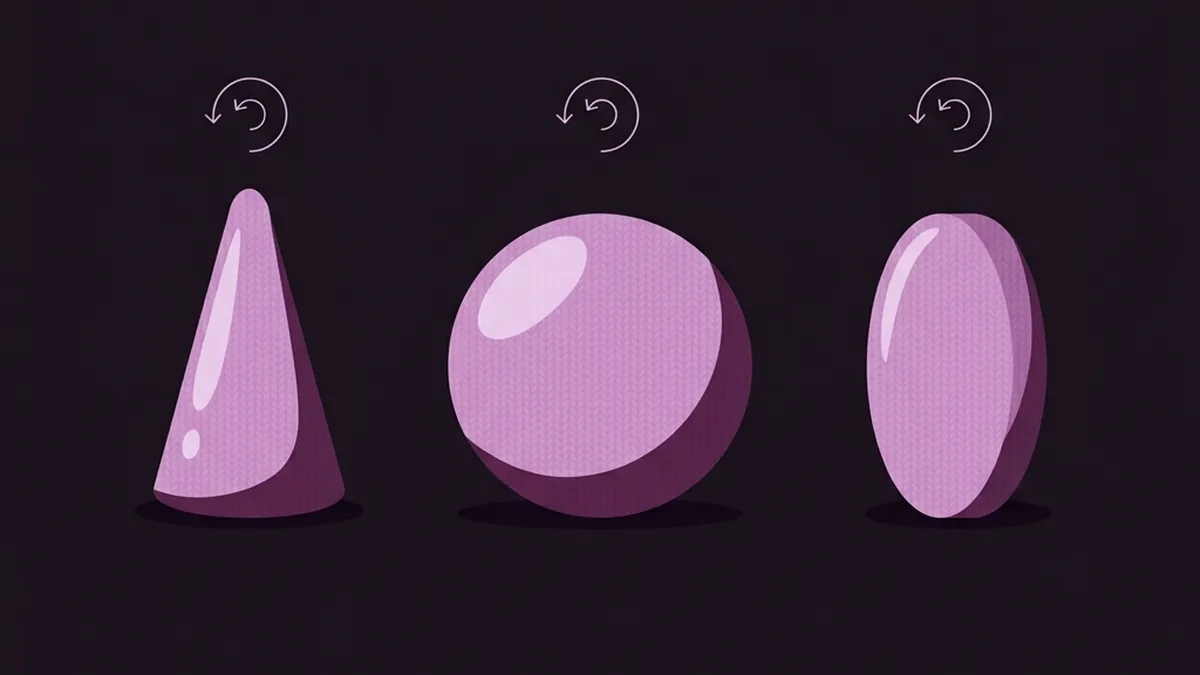
Why: The increases are at the wrong RATE. A sphere grows by six stitches a round for as many rounds as its radius, then stays straight for about as many again before decreasing. Increase for too few rounds and the piece runs out of width before it runs out of height — a cone. Increase for too many and it goes wide and flat before it can close.
What to change: Count the increase rounds against the straight ones. For a ball they should be roughly equal: five increase rounds, five straight, five decrease. If your pattern has three increase rounds and nine straight, you are crocheting a bullet, and no amount of stuffing will round it.
See the rounds a proper sphere needs →Why: The increases are in the wrong PLACES. Six increases spaced evenly give a circle; six increases stacked above each other every round give a hexagon with six visible ridges running up it. Most patterns avoid it by shifting where the increase falls each round — which is exactly what “6x (2 sc, inc)” does, since the group length changes as the round grows.
What to change: Stagger them. If your pattern stacks increases and you can see the corners, move each round's first increase along by one or two stitches. The count stays the same; the ridge disappears.
Why: The hook is too big for the yarn. This is almost always it. A ball band's hook size assumes a fabric with drape — a scarf, a jumper — and amigurumi wants the opposite: a fabric so dense it holds a shape and hides what is inside it.
What to change: Go down one or two hook sizes from the band, and expect the fabric to feel unpleasantly stiff in your hands. That stiffness is the point. If the holes are specifically at the decreases, that is a different cause — see the next one.
Why: An ordinary decrease works two stitches together and leaves a small gap where their tops meet, which stuffing finds immediately. It is not a mistake, it is what that stitch does.
What to change: Use an invisible decrease: work into the FRONT loops only of the next two stitches, then finish them as one. It sits flatter and closes the gap. Any pattern that says “dec” on an amigurumi means this one, whether or not it says so.
Why: Amigurumi is worked in a continuous spiral rather than joined rounds, so the start of each round is one stitch further along than the last. That drift is normal and invisible in a dense fabric. A LEAN, though, usually means the piece was joined and turned inconsistently, or the marker moved.
What to change: Keep a marker in the first stitch of each round and move it up as you go. If you are joining rounds with a slip stitch instead, join every round the same way and accept the seam — it is a different construction, not a fault.
Why: Too many stitches left when you stopped. Pulling six stitches shut leaves a pucker; pulling twelve shut leaves a visible rosette.
What to change: Decrease to six stitches, then fasten off leaving a long tail, thread it through the FRONT loop of each remaining stitch in turn — going around once, not through the middle — and pull. The stitches gather into the centre and the hole disappears. Then take the tail through the body and out somewhere else before trimming, so it cannot work loose.
Why: Too few anchor points. A limb sewn on through four stitches pivots on those four stitches, and a head sewn on through six will always nod.
What to change: Sew all the way around the join, catching every stitch of the limb's final round, and go around twice. For a head, stuff the neck firmly first — a soft neck tips however well it is sewn. Pin everything in place and look at it from the front before a single stitch goes in; a symmetrical toy with the ears on crooked reads as worse than an asymmetrical one.
When the shape is wrong, check the counts first
Two of the seven above are arithmetic wearing a disguise. A cone is not a tension problem and a hexagon is not a hook problem — they are increases at the wrong rate and in the wrong places, and both show up as a stitch count that stopped matching the pattern several rounds before the shape went visibly wrong.
So before re-crocheting anything, put the rounds through the round checker. If a count is out, the round where it first goes wrong is the round to unpick to — not the one where you noticed.
The one that is not a fault
A spiral has a step in it. Working in a continuous spiral means each round starts one stitch further round than the last, so there is a shallow diagonal running up the piece. Every amigurumi worked this way has it, including the ones in the photographs, and in a dense fabric nobody sees it. Joining each round removes the step and gives you a visible seam instead — a trade, not a fix.
Questions
- Why is my amigurumi head not round?
- Almost always the ratio of increase rounds to straight rounds. A sphere needs roughly as many straight rounds in the middle as it had increase rounds on the way up. Too few straight rounds and it stays a dome; too many and it becomes a cylinder with domed ends. Pointiness in particular comes from increasing for too few rounds before going straight.
- Why does my amigurumi have holes?
- The hook is too big for the yarn, nine times out of ten. Amigurumi is worked one or two hook sizes below what the ball band suggests, so that the fabric is dense enough to hide the stuffing. If the holes appear only at the decreases, use an invisible decrease instead of an ordinary one.
- What is an invisible decrease?
- Work into the front loops only of the next two stitches and finish them together as one. It leaves a flatter, tighter join than an ordinary decrease, which pulls both whole stitches together and opens a small gap between them. On amigurumi it is what "dec" almost always means.
- How much should I stuff an amigurumi?
- Firmly enough that the fabric is smooth and the shape holds when you set it down, and no further. Overstuffing stretches the fabric and opens the very gaps you were trying to avoid, so if stuffing makes the holes worse, the answer is a smaller hook rather than less stuffing.
- How do I close the last hole on an amigurumi?
- Decrease down to six stitches, fasten off with a long tail, and thread that tail through the front loop of each of the six in turn, going around the circle once. Pull, and they gather into the centre. Going through the middle instead leaves a dimple.
- How do I stop the head from tipping forward?
- Stuff the neck firmly and sew all the way around the join rather than tacking it at a few points. A head that tips is nearly always attached through too few stitches, or sitting on a neck that is softer than it looks.
Everything in Learn · How to read a crochet pattern · Free tools · Free patterns