
Free crochet tool
Crochet pattern resizer
Paste an amigurumi pattern worked in the round and rebuild it on a wider or narrower base. Every round is rewritten exactly — no rounding, no nearly — and the result is checked against the same engine that renders the 3D preview before you are offered it.
Pattern name: "Ball (M)"
start: magic ring

// generated from template: ball (M) — edit freely
Round 1: 8 sc in ring → 8
Round 2: inc x8 → 16
Round 3: (sc, inc) x8 → 24
Round 4-6: 24 sc → 24
Round 7: (sc, dec) x8 → 16
Round 8: dec x8 → 8
fasten off
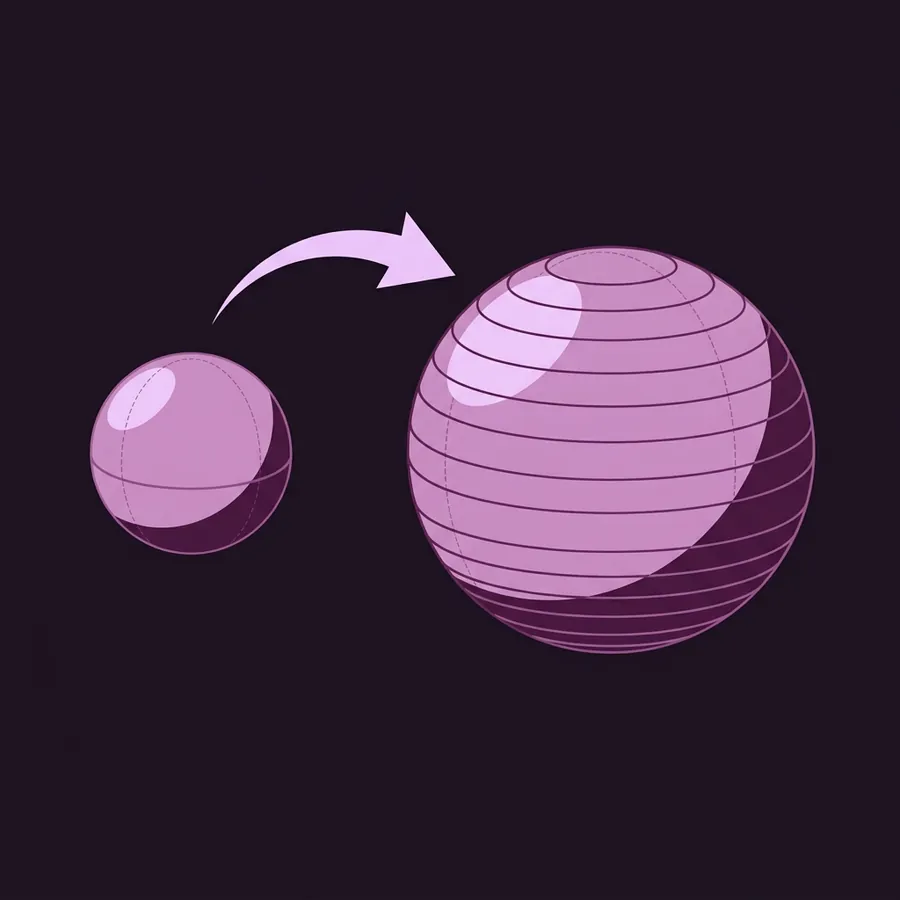
What “resize” actually means here
An amigurumi piece worked in the round is built on a base: the number of stitches in the magic ring, which is also how many the piece grows by in each increase round. Six is the convention. Rebuild the same instructions on eight and every round gets wider in the same proportion — the shape is identical, the piece is 8/6 as wide and as tall.
That is why the rewrite is exact rather than approximate. A round is either the base repeated (6x (2 sc, inc), which becomes 8x (2 sc, inc) — the stitches inside are untouched, because the repeat count is what carries the size) or a plain run whose count is a multiple of the base (18 sc → 24 sc). Both come out whole. Nothing is rounded, so nothing drifts.
Why it says no, and why that is the useful part
Some rounds cannot be widened by arithmetic at all. A round that spells its stitches out one at a time — colours placed to make a face, an ear built where the ear goes, a bobble at stitch fourteen — is drawn against a picture rather than counted against a base. There is no repeat in it to multiply.
So the tool finds the first such line, quotes it and stops. That answer is worth having: it tells you the pattern is not a size away from what you want, it is a re-chart away — and it points at the exact round where the work is. A resizer that guessed would hand you a pattern whose rounds no longer add up, which you would find out somewhere around round twelve.
The other way to change the size
Yarn. The same pattern in a thicker yarn with a correspondingly bigger hook comes out proportionally larger with no arithmetic at all, and it is the right answer more often than the internet’s habit of repeating it suggests. Changing the base is what you reach for when the yarn is already decided — you want this shape, in this yarn, bigger.
Questions
- How do I make an amigurumi pattern bigger?
- There are two honest answers. The first is yarn: the same pattern in a thicker yarn with a correspondingly bigger hook comes out proportionally larger without a single number changing. The second is to rebuild it on a wider base — a piece started with six stitches in a magic ring and grown six a round can be started with eight and grown eight a round, which makes it 8/6 as wide with every proportion intact. This tool does the second.
- Why not just multiply every stitch count by 1.5?
- Because a round is instructions, not a number. "6x (2 sc, inc)" means work that group six times; multiplying the 24 it produces by 1.5 gives 36, but nothing tells you how to get there, and the obvious guesses put the increases in the wrong places and give you a hexagon. Changing the base rewrites the instruction rather than its result, which is why the counts come out exact instead of nearly right.
- Why does it refuse some patterns?
- Because some rounds have no repeat to widen. A round that spells its stitches out one at a time — colourwork placed against a picture, an ear built mid-round, a bobble at a particular stitch — is drawn, not counted, and there is no arithmetic that widens a drawing. The tool names the line rather than guessing, because a pattern whose rounds no longer add up is worse than no answer.
- Does resizing change how many rounds I work?
- No, and that is the point. The number of increase rounds is what sets the shape; the base is what sets the size. Keeping the rounds and changing the base gives you the same object, larger. If you want a longer or squatter version, that is a different edit — work the straight middle for more or fewer rounds.
- Will the resized pattern still work in stitch counts?
- Every result is run through the same parser and compiler the 3D planner uses, and each round's count has to come out at exactly the old count times the scale before the pattern is offered at all. If it does not, you get a refusal rather than a pattern.
- Which base should I pick?
- Six is the amigurumi convention and eight is the other common one. Below five a magic ring stops closing tidily; much above twelve the first rounds ruffle before the piece finds its shape. Between those, the base is simply how wide you want it: the finished piece scales with it directly.